.png)

The Shape of IPR Institution Under Director Squires

Updated: Feb 17
Jan 29, 2026
For a long time, inter partes review felt like gravity. If you owned a patent and someone filed an IPR, it was less a question of whether you’d be dragged into the PTAB and more a question of how painful it would be. Under Director John Squires, that gravity is still there, but it’s weaker, more selective, and far more dependent on context. For patent holders and inventors, that’s a real shift, and a meaningful one.
Let’s start with the headline: IPR is no longer automatic. Institution rates have recovered from the near-freeze of mid-2025, but they remain far below historical averages. That tells us two things. First, the PTAB isn’t “closed for business.” Second, and more important for patent owners, petitioners now have to earn their way in. Showing a reasonable likelihood of invalidity is no longer enough by itself. Director Squires is asking a different question: why should the Office spend its limited resources re-litigating this patent at all?
That change alone alters the leverage equation. The PTAB is no longer a default pressure tactic; it’s a discretionary forum. And discretion cuts both ways, but lately, it’s been cutting in favor of patent owners who have acted like responsible owners.
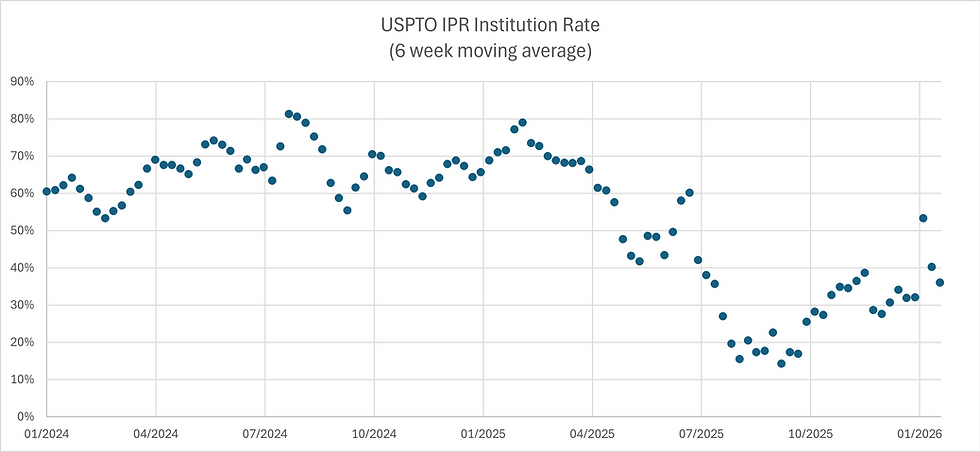
One of the biggest signals coming out of recent decisions is how much the age of a patent and the owner’s conduct matter. Patents that have been around for a while, and that have been licensed, commercialized, or enforced, are increasingly treated as having “settled expectations.” In plain English: if you built a business around your patent, or licensed it to others who did, the Office is less inclined to yank the rug out from under you years later.
This doesn’t mean younger patents are fair game. But it does mean that ownership alone isn’t enough. The PTAB is looking at what you didwith the patent. Did you put it to work? Did others rely on it? Or did it just sit quietly in a drawer?
And that last scenario matters more than many inventors realize. Several recent decisions show that sleeping on your rights can weaken your position. If a patent owner waits a decade to assert, tells potential infringers a license isn’t needed, or only files suit after the patent has expired, the equities start to flip. In those cases, the PTAB has shown sympathy for challengers who reasonably believed the patent would never be enforced. That’s not a technicality, that’s a warning. Delay is no longer neutral. Sometimes it’s evidence.
Another major shift favors patent owners even more directly: petitioners now have to go all in. In cases with parallel litigation, a Sotera-style stipulation – giving up all invalidity arguments in district court if the IPR is instituted – is basically mandatory. But it’s no longer a golden ticket. It’s the price of admission, not a guarantee of entry. For challengers, that raises the stakes dramatically. For patent owners, it reduces the “heads I win, tails you lose” dynamic that plagued the system for years.
Layered on top of that is a growing intolerance for gamesmanship. Petitioners who argue one claim construction in court and another at the PTAB without a compelling explanation are finding the door closed. Consistency matters again. That may sound basic, but it’s a real cultural shift and one that benefits inventors who have long been forced to defend against shape-shifting theories.
Stepping back, the emerging picture is this: IPR institution now looks a lot like equity practice. The challenger still has to show a likelihood of success, but that’s just step one. The PTAB is also weighing fairness, reliance, timing, and whether administrative review is actually the right tool for the dispute. That’s a far cry from the early years of IPR, when validity challenges felt almost mechanical.
For inventors and smaller patent owners, the practical lesson is simple but powerful. How you treat your patent over its lifetime now directly affects how well it can defend itself. Licensing helps. Commercialization helps. Reasonable, timely enforcement helps. Strategic silence, abandonment, or mixed signals do not.
IPR hasn’t gone away. But it’s no longer an automatic tax on owning a patent. It’s becoming a selective remedy, applied with judgment rather than reflex. And for inventors who view their patents as real business assets, not just litigation chips, that’s a change worth paying attention to.
About the author: Bob Fish
Bob Fish, Esq. is an intellectual property attorney working in Irvine, CA. He has a keen eye for the many absurdities that abound in the practice of law and has been bringing those to life for several years in a comic strip published in one of the leading industry journals, IP Today. Bob is also a Super Lawyer, and regularly contributes to California Business Litigation, a guide published annually by Continuing Education of the Bar (CEB). Outside of the office, Bob practices Aikido, enjoys numerous outdoor sports, and researches nutritional approaches to health and disease. Bob resides with his wife and son in Orange County, California.
Fish IP Law’s in-house artist: Dave Watson
He started doing work for Fish IP Law back in 2006 drawing the Patent Beast™ comics. He also illustrated several of Bob’s books, did the Museum of Patent Art™ pieces, and does all the caricatures found on the website. In 2018, he gave up freelance work and came to work in-house where he drafts patent drawings, produces the FishFAQ™ videos, makes the fishart™ canvases hanging on the walls at the office, and takes care of the website as well.


Comments