.png)


Should Your Patent Attorney Use AI? What Every Inventor Should Understand Before Filing a Patent

By Robert Fish, Esq. | Founding Partner, Fish IP Law LLP | Founder, The Patent Beast™
Artificial intelligence is changing how inventions are conceived, researched, documented, analyzed, and protected.
It is also changing the practice of patent law.
Today, AI tools can help analyze technical information, organize invention disclosures, search enormous bodies of information, identify inconsistencies, compare terminology, summarize references, and assist with portions of the patent-drafting process.
That raises an important question for inventors:
Should your patent attorney be using AI?
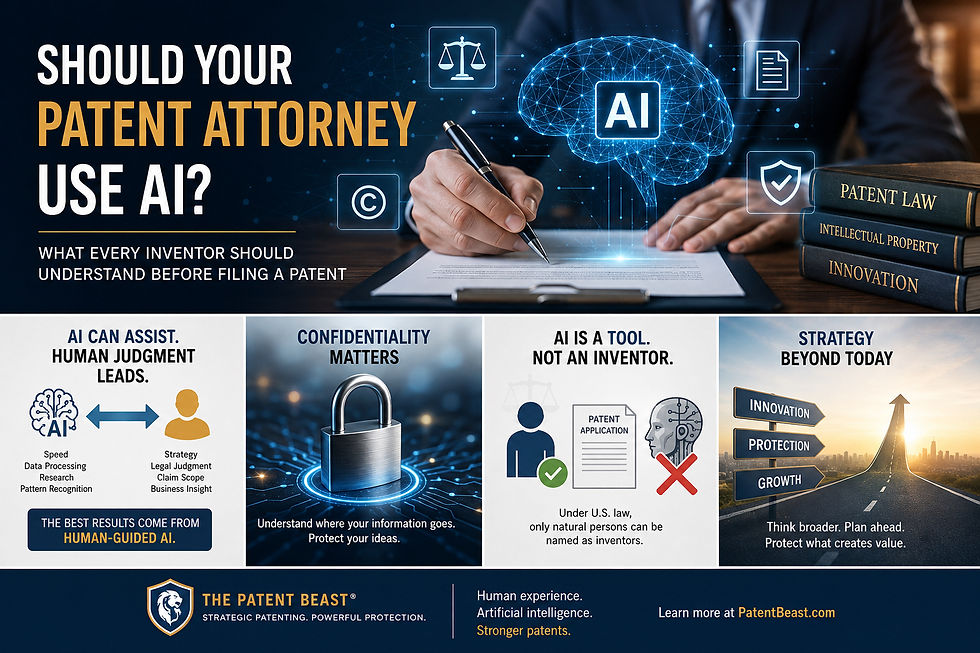
In many situations, the answer is yes—but with an important qualification.
The real question is not simply whether your attorney uses AI. It is how the attorney uses it, what information is given to it, how its work is verified, and whether experienced human judgment remains in control.

A patent is not merely a technical description of an invention. It can become a strategic business asset that affects competitors, licensing, investment, acquisition value, enforcement rights, future product generations, and the ability to build barriers around a market.
That is why the strongest model for patent practice is not “AI instead of an attorney.”
It is experienced patent counsel using AI intelligently, securely, and strategically.
Key Takeaways
Inventors should understand five things before allowing AI to become part of their patent strategy:
AI can make patent work more efficient, but efficiency is not the same thing as strategy.
AI-generated patent language must be reviewed and verified by qualified counsel.
Confidential invention information should not simply be pasted into an unvetted public AI platform.
AI can assist an inventor, but under current U.S. law an AI system cannot be named as an inventor.
The quality of a patent ultimately depends on human decisions about what the invention really is, what should be protected, and how broadly and strategically that protection should be pursued.
The goal should therefore be human-guided AI, not unsupervised AI patenting.
AI Is Becoming Part of Patent Practice
Patent attorneys have always used technology.
Patent databases transformed prior-art searching. Electronic filing transformed prosecution. Specialized software transformed docketing and portfolio management.
Generative AI represents another significant step.
Properly used, AI can help an attorney process large amounts of technical material much faster than traditional manual methods. It may assist with tasks such as:
organizing invention disclosures;
summarizing technical documents;
generating alternative terminology;
comparing concepts across references;
identifying inconsistencies in a draft;
brainstorming possible embodiments;
analyzing large collections of patent documents;
preparing preliminary research;
and assisting with portions of drafting and review.
Those capabilities can be extremely valuable.
But there is a dangerous assumption hiding behind the excitement:
If AI can generate a patent application, does that mean it can develop a good patent strategy?
Not necessarily.
Drafting Words Is Not the Same as Building Patent Protection
A patent application can be beautifully written and still provide disappointing protection.
That is because patent value does not come from the number of pages in an application or from how sophisticated the language sounds.
Value comes from what the patent ultimately protects.
An experienced patent attorney is therefore asking questions that go well beyond:
“How do I describe this product?”
The better questions include:
What is the inventive concept?
What aspects are likely to distinguish the invention from prior art?
What will competitors probably change when they try to design around it?
Which features are essential, and which are merely examples?
What alternative implementations should be disclosed now?
What does the inventor plan to build next year—not merely today?
Where is the commercially important white space around the invention?
These are strategic questions.
AI can assist in exploring them. It can generate possibilities and accelerate analysis.
But the ultimate decisions require technical understanding, legal judgment, knowledge of patent prosecution, and often business experience.
A system that generates twenty possible claim limitations has not necessarily identified the right limitation.
Sometimes the most important patent decision is knowing what not to put into the independent claim.
The Biggest Danger: A Patent That Looks Better Than It Is
Generative AI is exceptionally good at producing language that sounds authoritative.
That characteristic is useful—and dangerous.
An AI-generated patent draft may look polished while containing subtle problems.
It may unnecessarily narrow an invention.
It may describe one implementation without adequately supporting alternatives.
It may use inconsistent terminology.
It may overlook commercially important embodiments.
It may introduce technical assumptions the inventor never intended.
It may produce statements that later become problematic during prosecution or enforcement.
And, like other generative AI systems, it can simply be wrong.
This is particularly important because patent drafting involves decisions whose consequences may not become apparent for years.
A poorly chosen sentence today can become an argument about claim interpretation much later.
That is why AI output should be treated as work product requiring professional review—not as legal authority.
The American Bar Association reached a similar conclusion in Formal Opinion 512. Lawyers using generative AI remain responsible for professional duties involving competence, confidentiality, communication, supervision, candor, and reasonable fees.
AI does not transfer the lawyer’s professional responsibility to a machine.
Confidentiality May Be the Most Important Question Inventors Never Ask
Imagine spending three years developing a breakthrough product.
You have not publicly disclosed it.
You have not filed a patent application.
Then the entire technical disclosure—including drawings, prototypes, manufacturing details, experimental results, and future product concepts—is uploaded into a consumer AI platform without anyone carefully evaluating the platform’s confidentiality, retention, training, and security policies.
That should concern an inventor.
Patent attorneys routinely receive highly sensitive information before a patent application is filed. That information may include trade secrets, unpublished inventions, confidential business plans, prototypes, source material, competitive strategy, and research results.
AI therefore introduces an important due-diligence question:
Where is my information going?
California’s updated guidance on generative AI makes this issue particularly clear. Attorneys are expected to make reasonable efforts to understand how an AI product collects, uses, stores, and discloses information. Depending on the circumstances, that can require reviewing terms of use, privacy policies, vendor documentation, security practices, and data-retention policies.
The practical lesson for inventors is simple:
Do not assume that every AI system should receive confidential invention information simply because it is convenient.
Before sensitive material is entered into an AI system, the attorney should understand the system being used and the applicable confidentiality and security safeguards.
The USPTO Also Expects Human Responsibility
The United States Patent and Trademark Office has specifically addressed the use of AI tools in practice before the agency.
Its guidance recognizes that AI may be used in preparing and prosecuting patent and trademark applications. But the existence of AI does not eliminate the responsibilities imposed on practitioners and applicants.
The person submitting material to the USPTO remains responsible for the filing.
That matters.
An attorney cannot reasonably defend an incorrect submission by saying:
“The AI wrote it.”

The professional obligation remains with the human practitioner.
For inventors, this is another reason to distinguish between AI-assisted patent practice and AI-controlled patent practice.
The first can be powerful.
The second can create unnecessary risk.
Can AI Be an Inventor?
This is another area where confusion is common.
Under current U.S. patent law, only natural persons can be named as inventors.
In November 2025, the USPTO issued revised guidance concerning AI-assisted inventions and rescinded its earlier February 2024 guidance.
The USPTO’s current position emphasizes that the same established legal standard for inventor-ship applies regardless of whether AI was involved.
AI is treated as a tool.
It is not an inventor.
That does not mean an invention becomes unpatentable merely because AI was used somewhere during development.
AI can assist human inventors.
The critical legal inquiry remains human inventorship and conception under existing patent law.
For modern inventors, however, this creates an important practical reason to document the inventive process.
When AI is heavily involved in research or development, keeping good records regarding human decisions, technical insights, experiments, modifications, selections, and development can become increasingly important.
Inventors Should Keep Better Records in the AI Era
Historically, inventors were often told to maintain engineering notebooks and development records.
AI makes disciplined documentation even more valuable.
If AI is being used during product development, consider documenting:
the problem the human team identified;
the technical objectives established by the inventors;
significant prompts or instructions when relevant;
AI-generated alternatives that were evaluated;
which alternatives were rejected;
modifications made by human developers;
experiments and prototypes;
unexpected results;
technical decisions made by the inventors;
and the reasoning that led to the final implementation.
The objective is not to create paperwork for the sake of paperwork.
It is to preserve the story of the invention.
As AI becomes more deeply embedded in engineering and R&D, understanding who conceived what may become increasingly important.
AI Can Actually Help an Experienced Patent Attorney Think More Broadly
There is another side to this discussion.
Used correctly, AI can make an experienced patent attorney more effective.
Consider an invention with ten major components.
Each component may have multiple alternatives.
There may be different materials, architectures, communication methods, physical configurations, algorithms, manufacturing approaches, control systems, or business implementations.
AI can help rapidly explore that possibility space.
An experienced attorney can then evaluate those possibilities and ask:
Which alternatives deserve disclosure?
Which ones create useful fallback positions?
Which ones might prevent a competitor from making a trivial design-around?
Which combinations may support additional claims or future applications?
That is a much more sophisticated use of AI than asking a chatbot:
“Write me a patent.”
The difference is the human directing the process.
The Patent Attorney’s Job Is Becoming More Strategic, Not Less
Some people assume AI will make patent attorneys unnecessary.
The opposite may occur.
As generating technical and legal text becomes easier, judgment becomes more valuable.
If anyone can generate fifty pages of patent language in minutes, then generating pages is no longer the difficult part.
The difficult part becomes deciding:
what deserves protection;
what the prior art actually means;
how competitors may respond;
how claims should evolve;
what belongs in the specification;
what should remain confidential;
which jurisdictions matter;
how prosecution decisions affect business objectives;
and how today’s application fits into tomorrow’s IP portfolio.
AI increases the amount of information available.
Experienced counsel must convert that information into strategy.
What If You Already Used ChatGPT or Another AI Tool to Draft Your Patent?
Do not assume the work is useless.
But do not assume it is ready to file either.
An AI-generated draft can sometimes provide a useful starting point because it may help organize the inventor’s thinking and capture technical information.
Before filing, however, experienced patent counsel should examine the draft for issues including:
Claim scope: Are the claims unnecessarily narrow?
Support: Does the specification adequately support the claims and reasonable future amendments?
Terminology: Are important concepts described consistently?
Alternatives: Does the application disclose meaningful variations and embodiments?
Inventorship: Have the correct human inventors been identified?
Accuracy: Did AI introduce technical statements that are incorrect?
Prior art: Does the strategy account for the relevant technological landscape?
Design-arounds: Could a competitor avoid the claims with a relatively minor modification?
Business alignment: Does the application protect what actually creates commercial value?
The most expensive patent problem is not necessarily a rejected application.
It can be a patent that gets granted—and later turns out not to protect what the company needed protected.
Seven Questions Inventors Should Ask an AI-Enabled Patent Attorney
An inventor considering an attorney who uses AI should ask:
1. How are you using AI in my matter?
There is a major difference between using AI to organize information and allowing it to generate substantive work without meaningful attorney supervision.
2. Will my confidential invention information be entered into third-party AI systems?
The attorney should understand the confidentiality and security implications of the tools being used.
3. Does a patent attorney personally review AI-generated work?
The answer should not be ambiguous.
4. How do you verify AI-generated legal or technical information?
AI output should not be treated as inherently reliable.
5. Who develops the claim strategy?
AI can assist. Patent strategy should remain under experienced professional judgment.
6. How do you identify broader embodiments and possible competitor design-arounds?
A strong patent application should anticipate more than the inventor’s current prototype.
7. Is AI being used primarily to reduce labor—or to improve the quality of the analysis?
The best answer may be both. But inventors should understand what value the technology is actually providing.
The Patent Beast Approach: Human-Guided AI
At Patent Beast and Fish IP Law http://www.fishiplaw.com, the objective is not to choose between human experience and artificial intelligence.
The objective is to combine them intelligently.
AI can process enormous amounts of information, identify patterns, explore alternatives, and accelerate certain analytical tasks.
Experienced patent counsel contributes something different: judgment.
That includes understanding claim scope, prosecution strategy, business objectives, technical nuance, competitive positioning, and the practical consequences of decisions made during patent drafting.
Bob Fish and the Fish IP Law team have worked across technologies including medical devices, pharmaceuticals, electronics, software, business methods, mechanical technologies, chemicals, and other complex fields.
That experience informs how AI is used.
The machine can help explore the landscape.
The attorney still has to decide where to build the fence.
The Bigger Issue:
AI Is Accelerating Competition Too
There is another reason inventors should pay attention to AI
AI is not only changing patent drafting.
It is changing innovation itself.
Competitors can increasingly use AI to research technologies, explore alternatives, analyze products, generate designs, write software, investigate patent landscapes, and accelerate development.
An innovation that once took a competitor months or years to understand may become easier to analyze and reproduce.
That makes thoughtful intellectual-property strategy more—not less—important.
Inventors should therefore consider patent protection earlier in the development process and think beyond the immediate product.
Ask:
What is the broader invention?
What would a competitor copy?
What would they change?
What adjacent versions could they develop?
What should be patented, and what should remain a trade secret?
Those questions become increasingly important when innovation itself is accelerating.
Hear More on The Patent Beast IP Talk Podcast
This issue is also explored on The Patent Beast IP Talk, where Bob Fish discusses intellectual property, innovation, entrepreneurship, emerging technology, and the practical realities inventors face.
In a recent discussion with Curtis Hutten, Founder and CEO of YouLabs.ai, and Ania Alexakos, Co-Founder of YouLabs.ai, the conversation examines how AI is reshaping innovation, the risks it creates for businesses, and practical strategies founders can use to protect inventions, brands, and competitive advantage.
The central business issue is becoming difficult to ignore:
If AI allows competitors to understand and reproduce innovations faster, companies may have less time to build meaningful protection around what makes them different.
Watch and subscribe to Patent Beast IP Talk on YouTube for conversations about patents, trademarks, intellectual property, AI, entrepreneurship, and innovation.
Final Takeaway
So, should your patent attorney use AI?
Yes—when AI is being used as a tool rather than a substitute for professional judgment.
AI can help a good patent attorney work faster, investigate more possibilities, analyze more information, and potentially uncover issues that deserve additional attention.
But inventors should never confuse automated drafting with patent strategy.
The strongest approach combines:
human creativity + experienced patent counsel + responsible AI + business strategy.
AI can generate words.
It can generate alternatives.
It can analyze information at extraordinary speed.
But protecting an invention requires deciding what matters.
And that remains a profoundly human responsibility.
About Bob Fish

Robert “Bob” Fish, Esq. is the founding partner of Fish IP Law LLP and founder of The Patent Beast™. His practice spans patent strategy and prosecution across technologies including medical devices, pharmaceuticals, electronics, software, business methods, mechanical technologies, and chemical innovations.
He is the author of Strategic Patenting, White Space Patenting, Green Fields Patenting, and Patent Magic, as well as the creator of The Patent Beast™.
Learn more at PatentBeast.com and FishIPLaw.com.
Disclaimer: This article is provided for general educational and informational purposes only and does not constitute legal advice. Reading this article or viewing Patent Beast content does not create an attorney-client relationship. Patent rights, inventorship questions, confidentiality obligations, and AI-related issues are highly fact-specific. Consult qualified patent counsel regarding your particular circumstances.


Comments